Army, 1998-2009
Transportation and Information Operations Officer
BIOgraphy
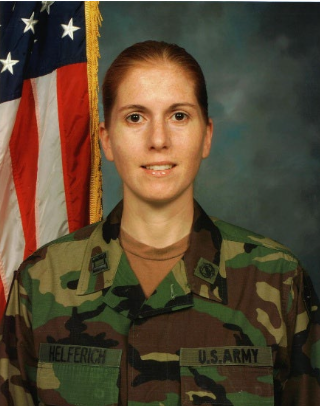
Major (Retired) Christina Helferich-Polosky was 100% disabled and medically retired by the U.S. Army in 2009 because of multiple physical and mental injuries and illnesses she suffered after 11+ years of successful active-duty service as a Transportation and Information Operations Officer. Most of her disabilities were later attributed to burn pit exposures that occurred during her combat deployments to Kuwait/Iraq (OIF) in 2003 with the 7th Transportation Group (Forward) out of Fort Eustis, VA where she was awarded the Bronze Star, and Bagram, Afghanistan (OEF) in 2008 ith CJTF-101 out of the 101st Airborne Division (Air Assault) from Fort Campbell, KY where she was MEDEVAC’d home after becoming seriously ill several months into the deployment. But some injuries—some wounds and abuse— she buried deep and couldn’t bring herself to talk about or report, until very recently. So, after decades of living in darkness and hiding the pain, she finally took steps to undergo Post-Tramautic Growth and several other different and unconventional forms of art therapy.
Art, in all its healing forms, for Christina—painting, sculpture and mixed media/collage—genuinely aids in helping her see that she is more than her broken past. A major component of her process lies in attempting to translate her confusion and sorrow into some sort of tangible art using whatever media is at hand. By physically displaying her story this way, it gives her separation to analyze her hurt instead of continuing to internalize it. She equally enjoys applying thick applications of acrylic paint mixed with heavy mediums on very large canvases as she does creating small intricate collages out of vintage scraps of paper and cloth, funding the “messy” part of making extremely satisfying on a very basic level. The resulting effects range from paintings with a very sculptural aesthetic to intimate collages with painterly constructions, finding peace between the crudeness and beauty of it all reflective of how she is feeling on the inside on any given day. Christina’s artwork has been displayed in national art exhibits at the Military Women’s Memorial, the Library of Congress, and the British Embassy in Washington, D.C., both Dulles International and Reagan National Airports in Virginia, and Walter Reed National Military Medical Center in Maryland—all through a nonprofit called UnitedUS.org, centered on healing through the arts, where she is a featured artist. She is also currently collaborating with award winning author Col. Lisa Carrington Firmin, USAF (ret.) by illustrating her most recent book Latina Warrior (Oct. 2023 – Blue Ear Books), an authentically raw autobiography told in poems, prose, and art. Most recently, she travels to events with Lisa to promote their book and share their process about successful female collaboration, as well as conducting art/collage workshops, artist talks, and panel discussions.
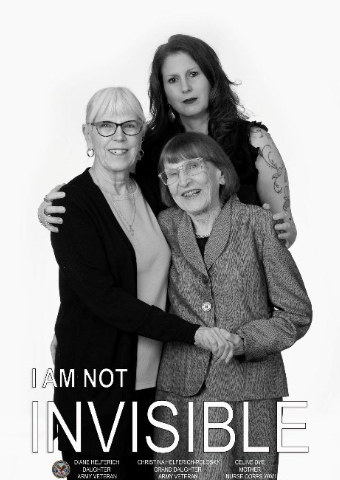
The power of art has finally set Christina on a true and healthy path forward to finding the voice she thought she lost, or had been taken from her, over all those years. Finally, she is able to express hat she could barely say out loud: “I may be wounded, but I am NOT worthless. Thus, as part of her specific healing process, she created the free online art gallery cooperative WoundedNotWorthless.com LLC for female military, veteran, and wounded warrior artists as a source of inspiration and empowerment as they all search to find their own true artistic vision and voice. Christina invites all female military-related artists to join her site for mentorship, writing guidance, and artist statement advice, as well as just discovering a safe space to share works and brands within a galvanized network of support. While she still has days where she feels like she is stick in the murky pit of her past, she now has a medium with which she strives to create a new self-narrative using her wounds as a positive source of inspiration. She accepts there will be good days and bad days and will try to create art through them all.

Deployments
Jason A. Higgins: I know the answer to this question, but for the record, did you deploy to a combat zone?
Christina Helferich-Polosky: Yes, I deployed early in 2003, served in Kuwait and Iraq for the actual war portion, so that was 2003. That was Iraq. And then 2008, I was deployed with the 101st Airborne Division as a strategic communications officer in, once again, early in 2008.
Jason A. Higgins: In Afghanistan?
Christina Helferich-Polosky: Afghanistan. Bagram, Afghanistan.
Jason A. Higgins: As I understand it, that would have been the invasion force of Iraq. Then in 2008, things were escalating in Afghanistan right?
Christina Helferich-Polosky: We were trying to escalate it. Yes, I was the— like I said, a strategic communications officer. One of our strategic goals was to shift the focus, the world’s focus from Iraq to Afghanistan so we could get more aid in the country, more funding for our soldiers who were there, and our bases and things like that. That was one of the major goals for me in my job.
Women in Combat Policy Gap
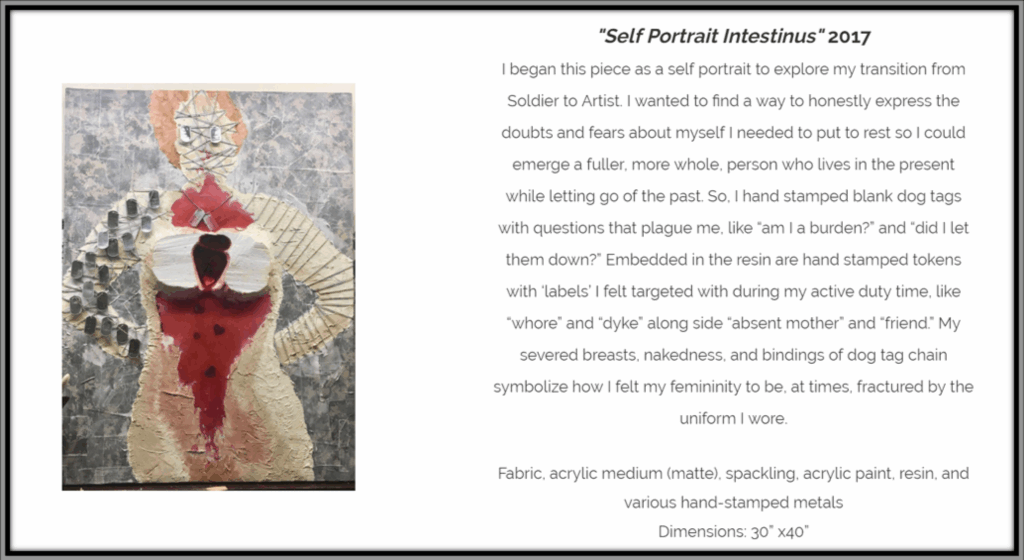
Art by Christina Helferich-Polsky
“Because women were not allowed in any combat at the time. They could be in combat support. So, we’re talking air defense artillery. They could be in M.I. [military intelligence] They could be in combat engineering, in field artillery.
But if they were in those, there were still jobs that were coded male-only. I chose combat service support because, in transportation, there was no labels at all. I thought at the time, naively, that women had a fair shake, because we were just right along with the men, and there were no jobs not coded for us. We had gunners, 50-cal gunners, and things like that. It didn’t matter male or female, and we were in the fight. I did an art project about this.
Before 2016, when Congress officially lifted the ban on women in combat, we had had over 163 women killed just in the post-9/11 era. From Afghanistan in 2002 all the way up to 2016. My question was, are these not combat-injured? They’re deployed. They were killed in convoys. They were killed in a lot of convoys. But we had military police. We had women in all these things. And I was like, but — So, my question was, “We weren’t in combat?” Because when you have bullets and mortars and RPGs fired at you, it feels like combat. That was the question for me, and I was really excited when the ban was lifted in 2016. The 2013 ban that they lifted, that didn’t really affect us on the ground. That was just— it seemed like semantics to us watching it. 2016 was the real because Congress said we don’t have— They undid the ‘women can’t be in combat.’ So, that was really— of course, I wasn’t in to see it, but we were really happy about it.”
Promotions and Sexual Harassment
“A commander I had, he told me after 9/11, which we were working 18 hour shifts because I was in charge of the flight line— My military control team was in charge of the flight line at Hunter Army Airfield, which is where the 3rd ID goes out of. It’s in Savannah, Georgia. We were immediately sending things to Afghanistan and Special Forces and things like that. We were working a lot, and my team did amazing things because we were still doing S4 and K4 operations, which were Kosovo and that. Those rotations were still happening when 9/11 happened. We were still doing those rotations the same time we were sending unique units out to Afghanistan when I worked there.
I gave him, this commander, my sheet because you have to give them like, “This is what I did for the course. You can write my OER,” which is officer evaluation report. You give them everything, and then they just look at it, and they write it down. The thing you wanted was a top block. You didn’t want a center block mass. You wanted a top block. I was told I wasn’t getting the top block because you can either be a good mother or a good officer, and I was going to have to choose. He literally said, it’s like, “You couldn’t have done all the things that you wrote.” I’m like, “Are you saying I lied? Are you questioning my integrity?” He’s like, “No, but— ”
My first ex husband, he left because I got chosen that command on the airfield, and he didn’t. We were in the same thing. He left to go to school early, so I was left with all the kids. It doesn’t make sense. He has an 8:00-3:00 job, so why didn’t he take the kids? But that was never even a discussion. The three kids that we had at the time: two in diapers … Now this guy is telling me, “I know you’re a good mother, so I can’t give you the top block because you can’t be both.” He was saying it in a way of, like, “This is just how it is. I’m giving you this nugget of truth. You want to be known as a good mother, not at a good soldier type thing and there’s no way you can be both. There’s not enough hours in the day.” I was like, “Do you say this to men? They can’t be good fathers?” He was like, “Well, that’s not the issue of this whole thing.”
I ended up signing it, and then I curled it up. I threw it at him, which totally should have been Article 15’ed for that. The only thing I heard later on was I met somebody in school after it was my turn to go to school, and they said, “I know you. This colonel says you don’t like him.” I’m like, “Really?” I’m like, well, maybe I did make an impression. But it was still wrong. A guy who wasn’t working 18 hours, who was working in the office as four, which is still a hard job but quartermaster. But I was like, at least give the props to my soldiers who were doing all this work. But it was totally negated, and he only had one top block to give, and he gave it to his staff guy. That matters because that guy, I followed his career. He got below the zone, which you got promoted faster and things like that because you had all the top blocks in your profile. When you get a middle block, even if it wasn’t in a command position, that matters. At the time, there was no DEI which is one of the best things that ever happened to the military because in the promotion boards: all white males. They were deciding our future. It is sociologically proven that you promote people who look like you, which is why it was such a great idea. They had to have a woman, and they had to have a minority on every promotion board. I knew it was working because they were complaining about it. So many white males were complaining about it. Of course, then it was like, everyone’s good, women and minorities another one getting promoted ahead of— Because you were supposed to get it? It was just like they didn’t earn it.”
Invisible Woman Veteran
Jason A. Higgins: …most people, I think, whenever they hear the word DEI, they don’t associate veteran with that. But veterans were really fundamental toward pushing for disability services and things like that. I guess my question for you is, as a woman veteran, do you often feel invisible in society? If so, what would you want the public to know about your service?
Christina Helferich-Polosky: That what people say matter. Words matter. I think we are getting better as a society of recognizing female veterans, but you still have that— You park in the veteran spot, and it still happens today. Of course, 10 years ago, it happened more, but it was like, “You can’t park there. You’re not with your husband.” I’d be like, “This is my car. Those are my stickers. Those are the wars that I was in. I’m the veteran.” Then they don’t say anything.
Christina Helferich-Polosky: Early on, going to the VA, you’d go up and check in, like, “Well, you can’t check in for your husband. He has to do that by himself.” “I’m not here for my husband; I’m here for me. Or being announced. They announce your name. They used to do this. They don’t do this before. The VA’s gotten very good at this, but they would say your name like Mr. Polosky or da, da, da. It was always assumed that the next patient was a male. I can’t tell you how many times, countless times I was called. Then actually recently, it happened again. There was something happening at the VA I was at there— I was in Alabama. That’s irrelevant but something was happening, and they are having some fair or something like that.
Christina Helferich-Polosky: I was actually with my daughter, too, but I was going in for my regular appointment, and they were like, “We’re only letting people in who have appointments or are you visiting somebody?” I’m like, “Well, no, it’s my appointment.” Then it didn’t hit that I said that. I just ignored it and just kept walking and they’re like, “Excuse me. You can’t come in unless—” I’m like, “Dude, it’s my appointment I’m coming to. Do I need to show ID?” You never have to show ID to get into a VA, except when you go up to the window or whatever but not to get in. That was within the last five years that that happened. It was like, I’m like, my gosh, this is still happening. I thought were doing so much better. But the thing is, he’s like, “Whatever. Forget it.” But there was no apology because it wasn’t a VA worker, it was a volunteer, which is fine. But it’s like, I’m going to let that go because I’ve had a lot of great therapy that I’ve been provided and so I’m just going to breathe and let it go.
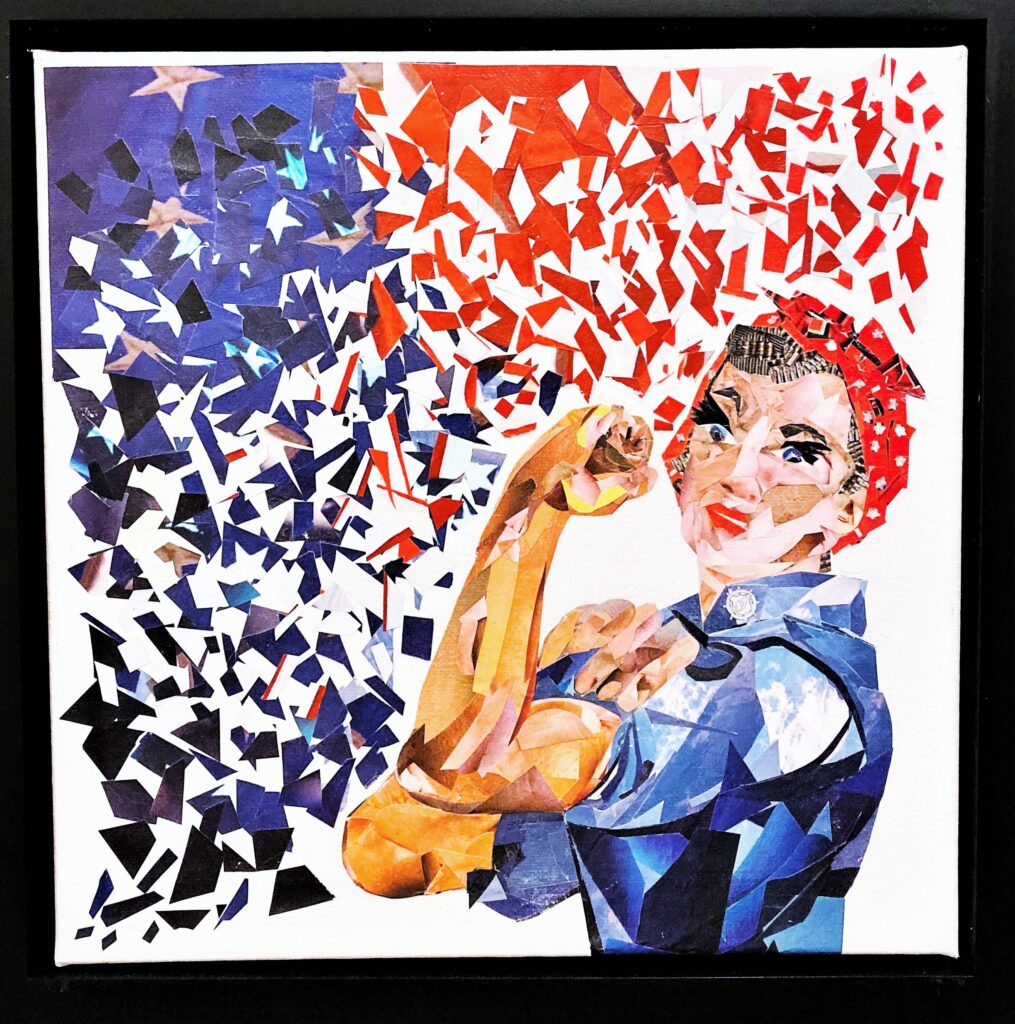
“Endowed by Her Creator” by Christina Helferich-Polosky
Family and Military Childhood
Jason A. Higgins: Well, you mentioned your daughter, and I know that you mentioned that your grandmother served, correct?
Christina Helferich-Polosky: Yes.
Jason A. Higgins: Your mother served in Vietnam?
Christina Helferich-Polosky: Yes. She’s a Vietnam-era nurse.
Jason A. Higgins: You served in the Iraq war in Afghanistan. How would you feel if your daughter wanted to join the US military?
Christina Helferich-Polosky: I have five kids: four boys and a girl. I’ve gotten zero to join the military. She can’t because she’s disabled. But she said, “Don’t even look at me, Mom. I’m not that fourth generation. I have absolutely no desire to join the military.” Our one son that really wanted to join, and that was his whole career path. He was diagnosed with Type 1 diabetes when he was 14-years-old. It’s a really strange thing to happen. I guess it does happen, but it’s very dangerous because you don’t know what’s happening, and we know of people who have sons, in the support group we go to, that died. They just went to bed and never woke up because they were in a diabetic coma. You didn’t know what was going on. But he was the one that really wanted— He’s so mad at his brothers. Because, of course, Type 1 diabetic can’t join, he’s like, “You guys, you have the opportunity to do it. You’re not doing it?” They’re all like, “No, man.” They’re like, “We have no desire.” Looking back, I can’t blame them because my daughter, when we were doing her college applications, she had gone to 13 different schools before she turned 18, across seven different states because I was still married to an active duty like her dad. We moved every one or two years.
Jason A. Higgins: That’s a hard life.
Christina Helferich-Polosky: It impacts our children so much. I’m now seeing some people starting to delve into the psychological effects.
Burn Pits
“I heard, I guess, that George Bush went on a ship and said, “Mission accomplished.” We never saw that because we didn’t have CNN because, in 2003, it was we were just living in tents with dirt floors. Burning our own fecal matter because we had to make our own latrines and things like that. Whereas men, they were lucky. They could just do a PVC pipe right into the ground, and they were good. But we had to burn our own poop with our JP8. That was something done daily. And because myself and Action Jackson were females, our tent was a little separated from the rest. And that’s where they— that’s where the barrel was. That’s where they did it every day that we were deployed. We’d fall asleep, and then the black smoke from that would go right through our tent because even in April and May— March, April, May is still very hot…
They were not realizing what we were doing. We were so focused on Saddam Hussein using chemical warfare on us that we didn’t even do that second thought of we’re burning everything. We’re talking plastics, tires, of course, our own human excrement. That was all being done unit by unit where it was, and so— We just never knew that it was something— We were wearing gas masks when they said— when the combat engineers would come on the line, and they’d be like, “We found some Iraqi ordnance and it’s not marked, so we’re going to blow it up.” They’re like, “Put on your gas mask.” And so, we would put on our gas masks, and then we’d fall asleep, and no one would wake us up to tell us it was all clear. We’d wake up, and it was drenched in sweat because you’re going to sleep in your MOPP gear [Mission Oriented Protective Posture gear].
But, it never occurred to anybody when we were blowing those things up that, even though they gave the all clear, what goes up has to come down. We were blowing up ordnance that wasn’t labeled. We didn’t know what it was. That was something else. People like me who weren’t deployed, the people who were there like a year, because no one had year orders. There was this thought that it wouldn’t really affect us anyway because we weren’t there long enough. But if you’re breathing that daily, you could be there one week, and you don’t know what you were inhaling. I didn’t realize when I got back that I was having skin issues, I was having things, but I had to take command of the five-weight medium truck company at Fort Eustis, Virginia.”
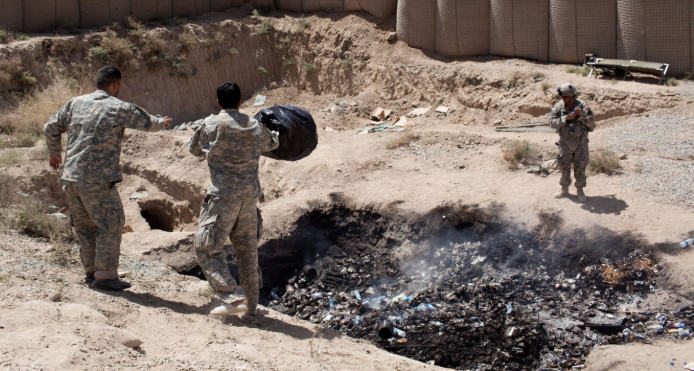
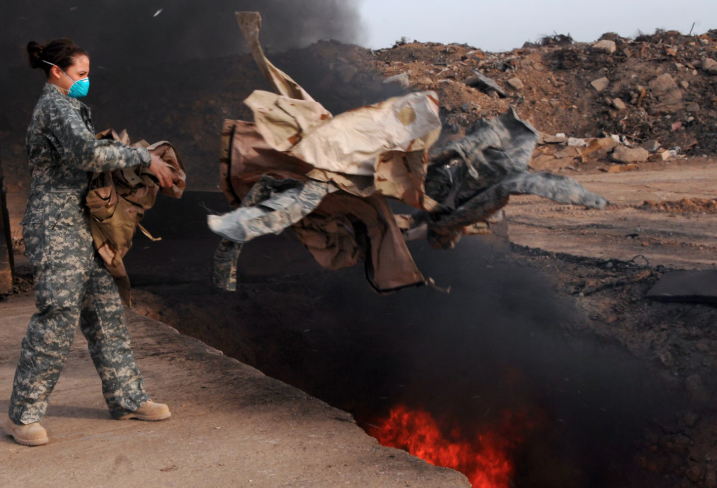
Jason A. Higgins: For the record, did your exposure to burn pits lead to long-term health consequences?
Christina Helferich-Polosky: Yes, absolutely. We weren’t aware of it at that time. When I deployed in 2008, and I was exposed to a different— We were at Bagram airfield, and it was an old Soviet airfield. There were places taped off where things were bubbling out of the ground. We were in our JOC, which is the joint operation center, was in an old hangar where they were bio-remediating asbestos as we— And they’re like, “This plastic sheet will be fine.” It was kinda like we slept right by the airfield and a black site, which weren’t supposed to know it was a black site, but everybody know it was a black site…where they would keep prisoners. So, you had other agencies that were in cooperation with that. But that actually, and it was literally walked past it every day. It was— There was something there that they actually notified people who worked there that, “Hey, you’ve been exposed to this.” It was like they didn’t notify us who were sleeping right next to it, but they were like— That was very rare at that time.
I was in my fifth month, and I had already had three anaphylactic reactions. Everyone was like, you know, “What is this?” You would think after the first one, maybe even the second one, they would have given me an EpiPen. But no. The third one, I stopped breathing entirely within seven minutes. My husband, at the time, I told my sergeant, “Go get my husband.” He was really upset that I had called for him. This was 10 o’clock at night. He was still working, but he came. He actually found me not breathing on the floor. Eyes swelled shut. Hives on hives and not breathing. He carried me to the entrance of the JOC, where they had a field—.
We have a field hospital, Level 1 care on Bagram, so I was very lucky for that. They did not have to intubate. They were able to get it down with whatever they pumped into me, and I actually woke up on the medevac plane to Landstuhl. My clothes were cut off of me. I had only— I looked like the Incredible Hulk because everything was like shredded. I had my ID card, and that’s all I had. So, when I got to Landstuhl they were like, “Well, we’re going to have to send you back. You can’t go back.” I’m like, “Oh, no, I have to go back because one, I got to finish my deployment because it was a year deployment, and the generals there and the chief of staff, they were like, “We need Helferich back.”