US Army 1981-2003
Obstetrician Gynecologist Medical Corps
Biography
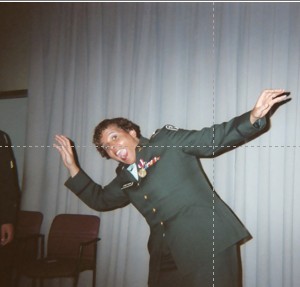
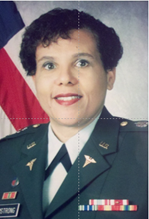
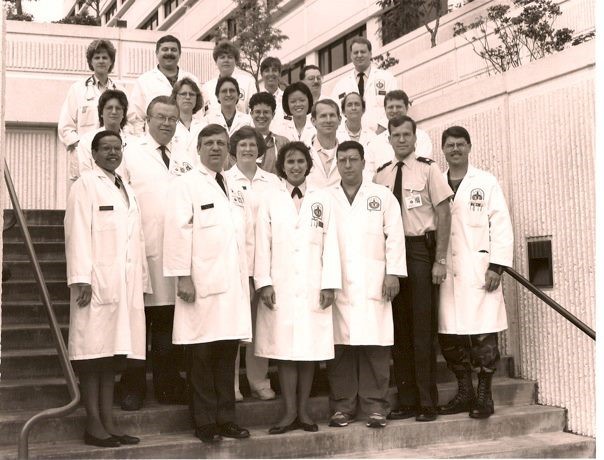
Dr. Alicia Christy is an African American author, artist, physician, and Army Veteran. She retired as Deputy Director of Reproductive Health at the Veterans Health Administration in 2023 . She holds the rank of professor at the Uniformed Services University, and adjunct professor at Howard University School of Medicine. Her military career began in 1977 when she received a Health Professions scholarship for medical school. She completed her residency in obstetrics and gynecology at Walter Reed Army Medical Center. She was assigned to Frankfurt Army Medical Center, Madigan Army Medical Center, and the Uniformed Services University. She ended her military career at Walter Reed Army Medical Center where she was chair of the obstetrics and gynecology department. Dr. Christy has had the privilege of caring for active-duty service women and women veterans for more than 40 years.
Outside of providing care in medical facilities, Dr. Christy’s leadership with advocacy and community volunteerism shows her devotion to mentoring, working for social change to improve the health quality for women of all races and ethnicities, and supporting programs to address topics such as homelessness, domestic violence, and military service. Her journey as an artist, professional illustrator, and physician activist are outlined in “A Legacy of Activism”, and “Art and Activism” published by the American College of Obstetricians and Gynecologists (ACOG). ACOG has also published her artwork and comments about patient advocacy and Black maternal health disparities in her articles and artwork entitled Standing With and For My Patients and Black Doctors Telling the Stories of Black Mothers.
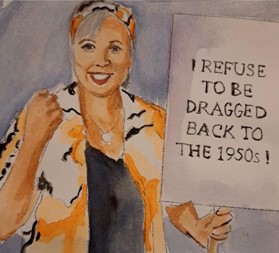
She advocates for health equity for women of all races and ethnicities. Dr. Christy is the recipient of the American Society of Reproductive Medicine Humanism in Medicine award, and the Cade Foundation Family Building Champion award. Her When Will Black Lives Matter, We must Speak for the Voiceless and Fulnerable, and Faces of the Fallen are just a few of her artworks featured by Art Against Racism, Academic Medicine, American Medical Association Journal of Ethics and many, many more. The awards and accolades Dr. Christy has received as a medical professional, military leader, federal employee, artist and active community member are substantial.
Additionally, she is a Uniting US Board Member and experienced facilitator who engages in programs to support healing, wellness, and community build. Blending her leadership experiences in the military, medical, and policy areas, Alicia’s selfless dedication is present in programs like Stories of the Fallen and the Rise of Women in the Military. She leads the Uniting US Faces of the Fallen portrait and stories program. Her series of portraits, “Faces of the Fallen: Women Proudly Served,” is a tribute to women who lost their lives in service to our country, including Lieutenant Colonel Karen Wagner, who was her Company Commander. LTC Wagner’s portrait was published in a special issue of Seminars in Reproductive Medicine co-edited by Dr. Christy. Her artwork has been featured in the Library of Congress, professional galleries, and in high profile public locations like Reagan National and Dulles International airports.

Positive Changes for Military Reproductive Care
Jason Higgins: What are some of the greatest changes that you’ve witnessed or experienced yourself in the military related to women’s health?
Alicia Christy: Well, there are a number, starting with the Pregnancy Policy, there’s been an increase in the number of days of postpartum leave—the number of weeks, of postpartum leave— and I think that has been a great benefit. And also, more information about guidance regarding services, and for the active duty, guidance regarding requirements for fitness training and fitness testing. And also, more recently, both within the VA and within DOD, some of the policies regarding not having to use leave to receive medical care, and so particularly for things like infertility care like IVF, that’s not available everywhere geographically, and the service members can’t control where they’re stationed, and so they did not have to use leave for those services.
Rescinded Policies for Military Reproductive healthcare
“Now, what has been rescinded, which I think is a real problem is many servicewomen—and again, they can’t control where they’re assigned—do not have access to abortion services, but they rescinded the policy and so now they have to use their leave to get medical care, and that is not true for other reproductive health services, such as infertility care if the care they needed is not available where they’re located.”
One Word Difference, Big Impact: Medical Abortion Policy in the Military
“It was life or health of the mother, not just life of the mother, as it is with DOD.”
Policymakers’ Dangerous Decisions for Civilian Reproductive Care
Alicia Christy: And there has been some legislation proposed, which is really barbaric, so for instance, in Ohio, not once but twice, the legislation tried to pass laws that would require gynecologists to put an ectopic pregnancy, a tubal pregnancy back in the uterus. Not only would that pregnancy not survive, it would jeopardize the health of the woman. And, so, it’s only in the area of reproductive healthcare that people with no medical training try to impose rules that can result in deaths of women that didn’t have to die.
Jason Higgins: Certainly, there are no equivalents to male healthcare, right?
Alicia Christy: No, there isn’t, as was pointed out in a Supreme Court justice hearing. And so, the other issue with it being life of the mother, not life or health of the mother, is that the case can then be reviewed and someone can say, “Well, they wouldn’t have died, and so therefore, we’re going to criminally prosecute you.” And so, that is the problem with a policy that doesn’t allow for consideration of health and not just that the woman would die without this care.
Jason Higgins: In this moment, in this kind of reactionary moment, you’ve witnessed and experienced extraordinary social change, y’know, since Roe v. Wade in the 1970s. Now we’re at this moment 50 years later, where it seems like that progress has taken back several steps.
Personal Healthcare Needs Story
“I’ll share a story that illustrates the fact that there can be policies in place, and you can have access, and it can still be an issue. And I think my situation is unique in that being a healthcare provider, my ability to navigate the system is very different than someone who is 19 and recently joined the military, so the fact that I was able to navigate the system and I’m able to get the services that I need, doesn’t reflect the entire population. And so I’ll use the example of the Pregnancy and Postpartum Policy, and so that policy was in place when I had my son at Madigan Army Medical Center in 1991, and my supervisor, who was a colonel, I was a major, volunteered to be my obstetrician. I didn’t ask him, he volunteered to be my obstetrician, and you’ll hear in the story why he did that. His nickname was Bottom Fish, so that should give you context. So, when I went to him and I said, “When I’m operating, I start contracting, ” he said, “Operate sitting down.” When I got admitted for premature labor, he had secretaries bring charts to my bed to review because I wasn’t “doing anything.” And when I was in labor, I had a temperature to 103. I was started on triple antibiotics. My son was in the intermediate nursery. And he came to my hospital room, I’m hooked up to an IV, he came to my hospital room and said, “I told the residents that you would cover my call for me on Labor and Delivery because you’re in the hospital anyway,” and ran away. So I went down to Labor and Delivery with my IV pole, and I said, “I’m on triple antibiotics. My son is in the intermediate nursery. I am not covering his call,” and they said, “None of us would be morally bankrupt enough to call you.” So there was a policy in place, but if the person responsible for following the policy is your obstetrician and your boss, where do you go to have someone advocate for you? And so, I think that’s the issue with any policy, and the importance of having external advocates that can ensure that the policies are followed, when the people who violate the policies are in positions of power over you.”
TW: Sexual Assault, Chain of Command, and Power Dynamics
Alicia Christy: So there was a policy in place, but if the person responsible for following the policy is your obstetrician and your boss, where do you go to have someone advocate for you? And so, I think that’s the issue with any policy, and the importance of having external advocates that can ensure that the policies are followed, when the people who violate the policies are in positions of power over you.
Jason Higgins: I want to ask this question, feel free to decline, okay? This same cultural and systemic issue that your story addresses reminds me a lot of the incidents of Military Sexual Trauma, and how the chain of command oftentimes is enabling the continuation of that to persist if the perpetrators are not held accountable to military justice. Do you see a connection between that?
Alicia Christy: Absolutely, and when I was at the VA, I was involved with a Military Sexual Trauma program at the Washington, DC VA, and I can’t remember the exact numbers, but a former Air Force JAG officer gave a presentation, and he talked about the number of cases that were reported, the number of cases that were prosecuted, and then the number of convictions, and it got down to, I want to say it was 3% were actually convicted. And so I think it creates a situation where people are discouraged, and in some cases, hopeless, and so I think there are a lot of cases that, one, aren’t reported, two, aren’t prosecuted, which points out in this area as well, the importance of having external advocates that are out of the chain of command.
TW: Abuse of Chain of Command: Going Against Pregnancy Postpartum Policy and SA
“I’ll use the example of the Pregnancy and Postpartum Policy, and so that policy was in place when I had my son at Madigan Army Medical Center in 1991, and my supervisor, who was a colonel, I was a major, volunteered to be my obstetrician. I didn’t ask him, he volunteered to be my obstetrician, and you’ll hear in the story why he did that. His nickname was Bottom Fish, so that should give you context. So, when I went to him and I said, “When I’m operating, I start contracting, ” he said, “Operate sitting down.” When I got admitted for premature labor, he had secretaries bring charts to my bed to review because I wasn’t “doing anything.” And when I was in labor, I had a temperature to 103. I was started on triple antibiotics. My son was in the intermediate nursery. And he came to my hospital room, I’m hooked up to an IV, he came to my hospital room and said, “I told the residents that you would cover my call for me on Labor and Delivery because you’re in the hospital anyway,” and ran away. So I went down to Labor and Delivery with my IV pole, and I said, “I’m on triple antibiotics. My son is in the intermediate nursery. I am not covering his call,” and they said, “None of us would be morally bankrupt enough to call you.”
Advice for Navigating the Military Healthcare System
Alicia Christy: What I tell patients in general is, “the best thing you can be is an educated consumer.” And, medical societies have a lot of excellent patient education sites. And, so for instance, American College of Obstetricians and Gynecologists has a women’s healthcare site that has excellent FAQs, they have videos, they have all sorts of information. The American Society of Reproductive Medicine has that as well, and I’m sure a number of medical societies have that. So, I always recommend to patients: be educated about your medical issues. And also, I tell them, “Think about what you want to ask and write it down because there’s a finite amount of time that the provider has, and you want to make sure that you get your most important questions answered.”
Jason Higgins: What are some of the common challenges that you’ve witnessed other women veterans face while applying for service connection?
Alicia Christy: Well, with gynecologic disorders, particularly if it’s something that can’t be objectively quantified— so, for instance, for service connection, let’s say you have fibroids or you have endometriosis, or whatever— the level of disability depends on the impact the condition has. Often, and this is true not just of women veterans or active duty service women, women often aren’t heard. Because of that, they may not be approved for the service-connected condition, or they may be rated at a lower level because the provider who makes the determination didn’t hear them or doesn’t believe them, or they don’t have appropriate documentation. The other thing, getting back to your earlier question about what would you advise a 19-year-old, is that you should make sure that you are knowledgeable about your medical information, and it’s important for you to make sure that that’s documented in your medical record. So, you might make the assumption that the information is there, and then when you try to adjudicate service connection, the information isn’t there.
Invisible Woman Veteran
Jason Higgins: A lot of women veterans I’ve talked with in my career interviewing women veterans have expressed feelings of invisibility, sometimes even betrayal. Can you relate to that?
Alicia Christy: Yes. Funny story, my husband had surgery at Walter Reed, where I had privileges, where I was on staff. And they referred to him as Colonel Christy. And he’s a civilian. So, it’s that type of thing, so people assume that it’s the man who’s a veteran, and because of that, it’s very important to me in my artwork to honor women who served, and so, on the 20th anniversary of 9/11, I did a series of portraits called “Faces of the Fallen, Women Proudly Served.” Because when people think about service members, they think about men. And particularly if you think about individuals that are killed in combat, you think about men. And I felt very strongly that these stories needed to be told, and their faces seen, and their sacrifice honored. And so, I think that is a big issue globally.
Jason Higgins: Does that lend itself to—You were wearing a hat whenever I met you earlier. Is that one of the reasons why you display your veteranhood very visibly?
Alicia Christy: I do, I do, because they’re gonna assume—the assumption is that you’re not a veteran. And so I, in certain environments where I feel that’s important to have my status as a veteran acknowledged, I will wear outward symbols of that. And the same is true of medicine because they’ll often assume you’re not a doctor, so I always wear a white coat. And I was covering one weekend and my white male colleague was wearing jeans, and he said, “You always get dressed up, and you always wear a white coat.” And I said, “Because as a Black woman, if I didn’t, they’d think I was with housekeeping.” And I’ve actually had a patient actually grab my ID badge and say, “Who are you? I haven’t seen you before.”
Jason Higgins: Wow. I’m laughing not because it’s funny, but that’s assault.
Alicia Christy: That’s assault, and I said, “Well, I’m the former chair of this department, and you probably saw a trainee, which is why you don’t recognize me.”
Jason Higgins: Did you drop the microphone as you walked out the door?
Alicia Christy: No. [laughter]