US Marine Corps, 1999-2003
Motor Transport Operator
Biography
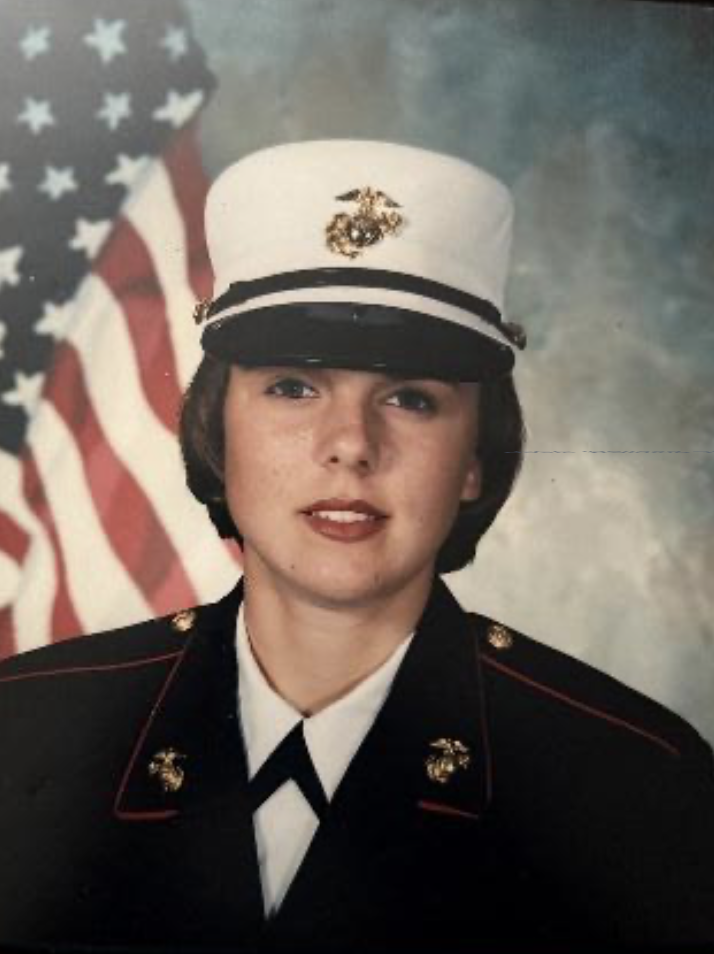
Melissa Anne Sias (Tybor), born December 25, 1979 Amsterdam, NY. A proud mother of two, United States Marine Corps Veteran-Motor Transport Operator-2x MST Survivor/Advocate, retired chef/restaurant manager, Artist and small business owner. A long time California transplant who spent years away on active duty, traveling the country, parts of the world, balancing her career, and raising her children. She returned to Upstate New York while juggling divorce, bi-coastal parenting, and life with disabilities.
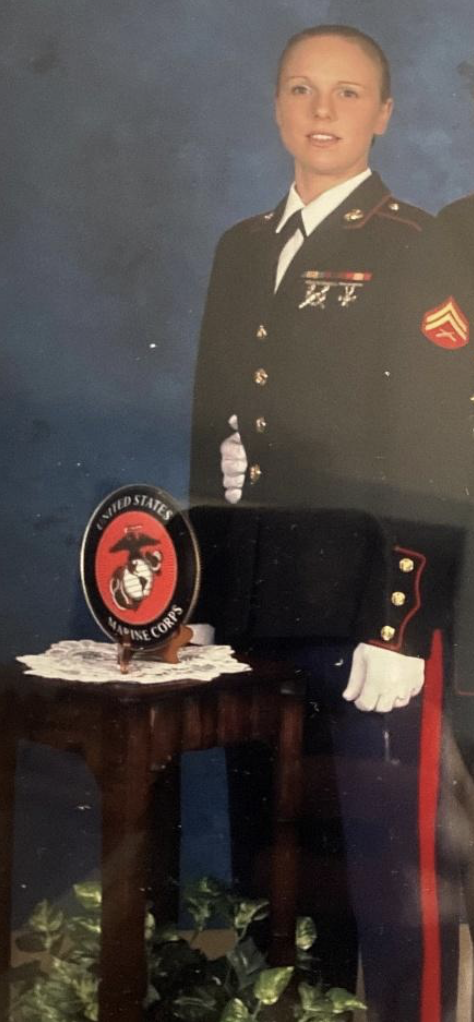
Piloting through extreme adversities, she began experimenting with new and holistic ingredients for her “therapy salad”. This included traditional methods, as well as adding in equine and writing therapies. It was at this time she discovered the pivotal and life saving role that painting and mixed media would play in her life, therein adding “art therapy” to her regiment.
She now utilizes a combination of these mediums and techniques as a healthy way to communicate and ground herself through creative expression; while she navigates the obstacles and complexities that accompany the challenges and limitations related to physical and mental disabilities.
Melissa now spends her days creating art at home, and also with her favorite group-Art4Vets, attending Veterans Writing Workshops, becoming a published writer, and continuing to seek out opportunities for advocacy work through groups like UnitingUs.org-VA Tech Rise of Women in the Military, and grassroots activism with the Wounded Warrior Project. She is a small business owner selling her art and creative works. As well as donating pieces to charitable organizations supporting veterans and persons with chronic illnesses. She is a full time artist, and 100% service connected disabled veteran.
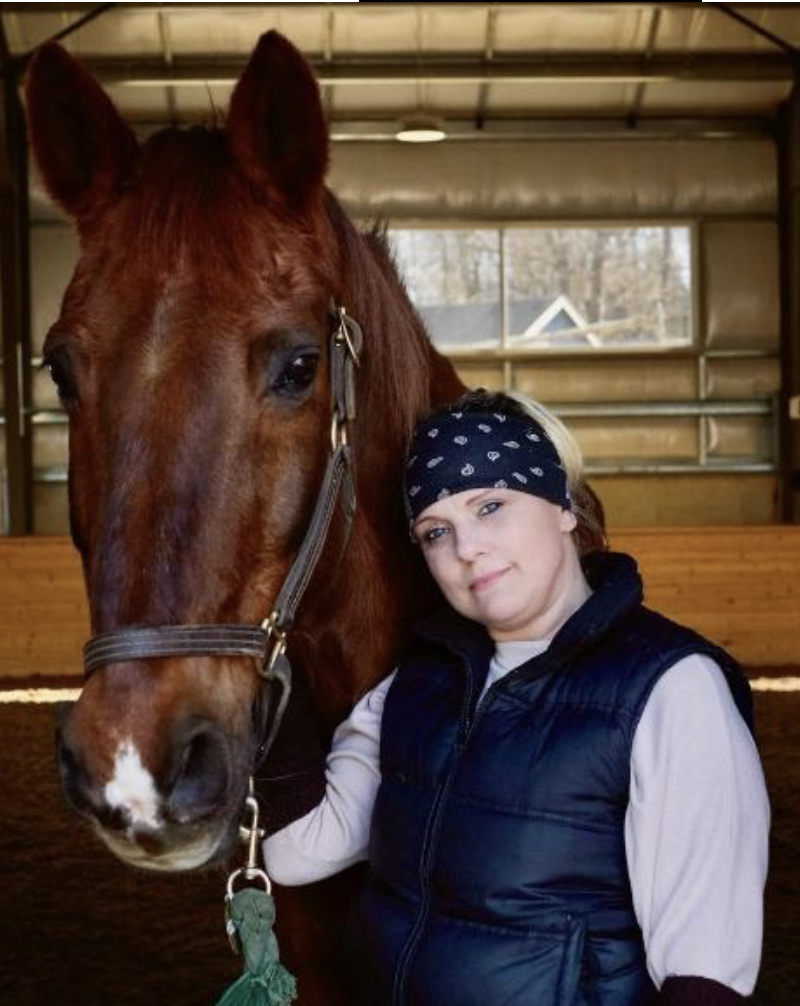
She is a passionate advocate openly speaking out about the misunderstood and unacceptable stigmas relating to the veteran and disabled communities, MST (military sexual trauma) survivors, complex PTSD survivors, adult diagnosed ADHD/Autism, suicide prevention, addiction/sobriety/recovery, and the importance of providing proper care, educational programs, treatment and support-mentally and physically, within our veteran community. Melissa is a powerful advocate visiting Capitol Hill and other leaders to discuss and advocate for legislation pertaining to the future of women veterans and their proper health care and support systems.

Deployment
Jason Higgins: What were the dates of your military service?
Melissa Sias: January ’99 to January ’03.
Jason Higgins: What branch did you serve in?
Melissa Sias: I was in the Marine Corps.
Jason Higgins: Marine Corps.
Melissa Sias: I was a 3531 motor transport operator. I drove really big trucks. Humvees, five tons, 5,000 gallon refuel truckers to refuel helos and aircraft.
Jason Higgins: This is your favorite question.
Melissa Sias: My favorite question. Did I deploy to a war zone? No. I did not serve in combat. But when I was stationed at my last duty station in Twentynine Palms, we would get the troops who were getting ready to go to Iraq and Afghanistan, and we’d be training them on the expeditionary airfield, showing them how to set up fuel cells, how to refuel on the flight line, how to properly operate the trucks and the trailers.
Jason Higgins: You were preparing other people ready to go to war.
Melissa Sias: The only reason I think I didn’t go is because I was pregnant when 9/11 happened. My daughter was born that December, and me and my husband at the time were actually in the same unit, so I don’t think they wanted to deploy both of us at the same time. But they had told me, “You’re going to shit your kid out and you’re going overseas, so get ready and give me three months to be back into regs.”
Women in Combat
Jason A. Higgins: The focus of this particular project has been about policy changes that affect the experiences of women in the US military. You’ve seen the timeline of major policy changes. Were there any that you care to speak to that are relevant to your personal experience?
Melissa Sias: There’s women in combat now, that never used to be a thing. There’s women pilots, which I wanted to do, but I found out I was pregnant and didn’t go to OCS. I decided to have my baby. But yeah, I had wanted to fly really bad when I was on active duty. I wanted to go to officer candidate school, take that route, finish college, go become a pilot. They would not let it. They were not having it.
Jason Higgins: Because you’re a mother?
Melissa Sias: Because I was a mom and a female. They did not want me in the cockpit. That’s not where we belonged. I was lucky to even be driving trucks. I should have been behind an office desk training people and filing paperwork which was an additional duty I got because I was the only one. I was the only female in a motor pool of 60, 70 people, maybe, and apparently the only one who knew how to use a computer and file properly. I became the training NCO. The office pogue, they call them for people who do all the office work in addition to your normal responsibilities. The accommodations for females, acceptance has definitely changed. Like she was just staying upstairs, there’s a 12 month time frame now after you have been for maternity leave. You didn’t get that. That’s definitely different. I can’t think of anything else off hand right now.
Military Sexual Trauma Experience (TW)
Melissa Sias: I was a domestic violence victim in high school. I was in a very abusive relationship, and I was really lost. I started a semester college after high school, and I just couldn’t do it. I studied criminal justice. I wanted to be a cop. I have a bunch of family that’s cops. I wanted to be a cop. I started studying it. It just didn’t sit well with me. I don’t know. I wanted something more. I wanted to get the hell out of Upstate New York and done with the cornfields. I wanted to see the world. Being from a poor family on welfare, you don’t have money for college. You don’t get given opportunities, so I went out and made my own. I joined the Marine Corps because I like the blues the best and didn’t do any research on the branches. But that’s where the trouble began was with my recruiter. He was the first assault that I ever experienced.
Jason Higgins: During your enlistment?
Melissa Sias: My recruiter, my very recruiter. After he assaulted me, I was supposed to leave in June of 1999, but I left in January, because I wanted to get the hell out. I just wanted to get away. I didn’t know how to handle what had just happened to me. He drugged me. I woke up the next day. I was in a place I didn’t know where I was completely naked and didn’t know how I got there. It took a long time to process that. I didn’t, obviously at the time. I just kinda just ignored it, moved on. I don’t know. I didn’t know how to handle it. I was 18, just turned 19.
Jason Higgins: Who does know how to handle that? That’s a betrayal in the very first moments.
Melissa Sias: It’s somebody who’s supposed to have your back in a good way. But unfortunately, he also did it to several other women, which is why I have my service connection now because it was all documented. To be honest with you, I don’t know what ever happened to him. I wonder if there would be some closure in finding out if he did get kicked out or if he got penalized for it. But if he didn’t, I don’t know if that would warp me more mentally. I just left it alone. He did it to several other women, and that’s why I got my rating because it was all documented. Unfortunately 99% of them women up there had to literally fight for 15, 20 years to get their MST claims approved. I was blessed to have documentation. I’m not going to say lucky because it’s not a good word, but the positive of that situation was it was all documented. Not that they didn’t make you relive it when you had a document, like file for your claim. They literally made you go through every little detail. We were getting to that. I’m going ahead.
Jason Higgins: That’s okay.
Melissa Sias: Let’s go back.
Jason Higgins: Did you report it at the time?
Melissa Sias: I didn’t. I was so scared. I felt I was embarrassed. Dude, how does that happen to me? No way. I was a good girl. I ran track, played soccer, did all my sports, chorus, band, total dork in high school. I was concentrating on my studies, was always good, followed the rules, did what I was told, kept my mouth shut. I did not know what to do when that happened.
Boot Camp
Melissa Sias: … Yeah, it was quite traumatizing stepping off that bus to those yellow footprints.
Jason Higgins: Did you have women instructors?
Melissa Sias: Oh, yeah. Five crazy broads. Relentless, determined, very focused, and very good at making a point. I learned very quick that, even though you’re a track star, you don’t try to show up your drill instructor. First day, I ended up on the quarter deck. It was a learning— It was literally a mindfuck.
Jason Higgins: What did it take to complete boot camp? What was that like for you?
Melissa Sias: That’s a loaded question. Strength, physically I had been conditioning for a long time because, from eighth grade on, I was always involved in sports one or the other, whether it be indoor or outdoor track, soccer, swimming. Then, it was band course. I always like to stay active and busy. I liked quality work, so I thought that that would transfer over, but it wasn’t just that. It was them constantly fucking with you and testing you and breaking you down to make you feel like the biggest piece of shit in the world to build you back up the way they wanted you to be because when they say “Duck now. Ask questions later,” it could save your life. You’re not thinking about that. You’re trying to prove a point at the time. It was a huge learning experience. A lot of sucking it up and just doing what you’re told and taking shit you didn’t want to do.
Jason Higgins: Was there a single moment where you went through the rite of passage, like you became a Marine?
Melissa Sias: Yep, the night— We had to do a crucible, it’s called that then for our boot camp to complete. Then, we go across the parade deck, and they present us with our EGA or Eagle, Globe, and Anchor. I think it was a 10 or 15 mile hump to complete the crucible. My pack— Which I had to guzzle a gallon of water to make weight to get in the Marine Corps. I was under. I couldn’t make weight. I got in there, and mind you, I’d come out of an abusive relationship. I was physically and mentally already warped, didn’t know it, had problems with eating disorders, started putting on weight, had a problem. Finally, I got that off. Made it through. The night before the march, I dropped a 90 pound pack on the bridge in my foot and broke my foot and had to hump the whole way with a broken foot hairline fracture. [I] didn’t even know it until after. I want to say. I don’t remember exactly if it held me a little bit, and I graduated the following week or if I actually graduated on time. I don’t remember. Some of it’s a blur. It’s crazy how that works.
Jason Higgins: Sleep deprivation.
Melissa Sias: Yeah. That and a lot of stress. But then again, there’s certain things I remember clearly. Being bunked with the worst girl in the platoon because they wanted to test my patience, and they wanted to see if I could help her out. This is somebody who flags the whole firing line with a loaded weapon after being told not to. Oh yeah, I had my work cut out for me. One experience that does stand out for me: my one drill instructor calls me up to the front of the line. “Get up here.” “Yes, ma’am.” You stand up there in your position of attention. You’re scared shitless. You don’t know what to do. She’s like, “Spell Schenectady!” I lost my composure for a second. She’s like, “I ain’t fucking moved. Spell Schenectady!” I was like, “S-C-H-E-N-E-C-T-A-D-Y, ma’am.” “Get the fuck out of my face.” What the hell was that all about? Then my mom, she would send me cookies. This bitch would always steal my cookies and make me pay for it on the quarter deck, and she had fun doing it. Come to find out the day we graduated boot camp, she walks up to my mom, shakes her hand, says, “Thank you. I’m from Upstate New York, and I haven’t had Freihofer’s cookies since before I joined the Corps.” She made my life a living hell over some stupid cookies because that’s where she was from. I’ll never forget it. Sergeant Williams. That woman, she was about five foot nothing and full of piss and vinegar. She scared the shit out of me. She was crazy.
Jason Higgins: How did Marines uplift one another?
Melissa Sias: No matter how bad it got, no matter what you were going through, — I don’t care if you needed a gallon of milk, a ride to the store, money to pay a bill— you always hide each other’s back. Always. That’s why being assaulted really fucked with me mentally because the camaraderie that we shared, I’ve never seen it anywhere else in my life. Ever, never in the civilian world.
Reading of “Can’t Have It”
“The phone rings loudly across the bay of the motor pool, interrupting the usual conversations and clanking of tools. Without warning, a masculine voice cuts through the calm. ‘Hey, Shower Shoe. Get your ass up here.’ —That’s the officers yelling from the office.— While she innocently, selflessly, and steadfastly defends, protects, and supports her country and fellow sisters and brothers in arms, she’s completely unaware or prepared for the friendly fire about to rain down upon her when she answers the call.
We were ready, willing, and able to void your entire enlistment. No desertion, no other than honorable or medically separated blemish on your record anywhere. We’ll make it appear as if it never even happened. In an instant stripping away dignity, rights, privileges, and freedoms which she coveted and held sacred.
She thought, “Unfortunately, pal, that is impossible.” How dare you propose some pitiful offer of a token as a token of your sympathy for my pain and suffering? How dare you try to strip away my responsibility to the people, my respect earned, and my dignity and integrity? Because, regardless of their opinions, thoughts, feelings, beliefs, and half-ass attempts to cover up the truth, it all did happen, none of which can be taken away. Not the violation of a sworn oath, not the assault on a young mind, body and soul and certainly not their attempt at a half-ass character assassination.
Rising like a phoenix from the ashes, she avenges all challenges, obstacles, and adversities that stood in her way. She singlehandedly, painstakingly, and triumphantly overcame what was sent to destroy her. Despite all the disbelief, the overwhelming odds against her, and the excruciating physical and mental anguish she endured, she steadfastly maintained the highest level of integrity and esprit de corps.
Through it all, one constant remains her title of Marine was never acquired, bought, or even gifted. Instead, it was earned. That being said, how does one respond to such a ridiculous gesture? Well, one keeps her uniform, her camaraderie, her family, her integrity, her pride, and her title, because that they can’t take away. Without hesitation, she boldly states in her rhetorical reply, ‘Is that the same proposal you would offer your very own sister, mother, grandmother, daughter, or wife?’ Calmly, she replaces the phone in its cradle, turns and walks away, head held high, chin up, shoulders back, as any good Marine would do.”
Military Benefits and Lack Thereof
“Where’s the camaraderie? Where’s the guidance? Where’s the support? … I did a lot for people that I don’t even know to support, defend, and uphold the Constitution of the United States against all enemies: foreign and domestic. Where’s that for me? That’s all. I just wonder where the reciprocation is.”
Pain, Addiction, Sobriety, and Healing
Jason Higgins: As you transitioned into your civilian life, what was that like?
Melissa Sias: It’s still really difficult. I’m still having problems. Especially accessing benefits and stuff like that I worked for and I earned, like, my Social Security, disability, finding representatives, finding the support, it’s such a double-edged sword. You had the camaraderie, but I also got assaulted. But I really had the camaraderie, and it was really helpful. When you needed somebody, somebody was always there because, even though there was two bad apples, everybody else always had your back. You had the community; you had support; you had friends; you had a family, no matter where you went. You don’t get that out here. Everybody’s for themselves, and nobody shows compassion to anybody else. It’s disgusting. First person that’ll throw you under the bus, do it in a heartbeat if it advances their career. After the military pumped me full of opiates for how many years because of my endometriosis and hysterectomy and all this other shit, I had an addiction and couldn’t get rid of it: alcohol, substances.
… Somebody introduced heroin to me as crushed Oxy, and I believed them. Then, I had a heroin addiction which I quit cold turkey because I didn’t want it no more. I wasn’t trying to be a drug addict; I was trying to self-medicate myself out of pain. I am so physically fucked up. I have a string of herniated discs between my neck and my lower back. I just had a hip replacement a year and a half ago. My knee’s been operated on twice. I have had two C-sections, hysterectomy, two rotator cuff surgeries, several endometriosis surgeries. I’ve lost count, I can’t even keep up. Then the mental on top of it because of the PTSD and all the flashbacks and the trouble sleeping and just adjusting, I can’t even leave my fucking house anymore without mentally preparing myself
Jason Higgins: Was it the VA that was prescribing the opioids?
Melissa Sias: Yeah, because they’re like, “Oh, you’re in pain here, just take this because of the endometriosis.” It was before I had my hysterectomy … Pump me full of opiates. Then they just stopped cold turkey. Anybody who’s been on opiates knows your body writhes in pain, and it takes weeks for your body to adjust to the chemicals that are not in there anymore.
Jason Higgins: Well, I’ve heard a lot of veterans say that they were given opioids, and then the VA had a policy change on prescribing opioids, and they just take from that.
Melissa Sias: They just take them away.
Jason Higgins: Then that leads down that path to heroin because it’s cheaper and easier to find … Do you mind if I ask how long you’ve been sober?
Melissa Sias: I’ve been sober six years in July from drinking and other substances, three years … It wasn’t due to any doctor. It was sheer determination and willpower, educating myself. No wonder I couldn’t figure out what the fuck was wrong with my mind and my body; and why everything was failing me; and why I couldn’t act normally in a normal setting; and be this normal individual in society. Well, I never took the time to consider the TBIs [traumatic brain injury/ies], and the drinking leads to blackouts. It’s taken years of therapy and education to find alternative healing.
Strength and Advocacy
“Just because I don’t look disabled doesn’t mean there isn’t shit wrong with me. But even though there’s all that’s wrong with me, I’m still a strong motherfucker, and I will persevere. Don’t tell me I can’t do something because I will make it my life’s mission to prove you’re wrong. I think that’s why I’ve made it this far in life.
I’ve always been told I was too this, not enough of that, ignored, beaten on, abused. It’s really given me thick skin. It’s also given me the ability to have compassion and love for other people. You know what I mean? I know how it feels to be treated like shit, so I don’t do that to other people. I’m a huge believer in women empowerment. We have got to have each other’s backs. When 100% of every female veteran that I’ve met and interacted with is a military sexual trauma survivor: unacceptable. We’re some hardcore bitches. I’ve been through a lot, and we’ve had to fight tooth and nail to get what we worked for and earned. Don’t underestimate us. We’re not done yet.”